Selenium as an Essential Micronutrient in Poultry Nutrition
1. Introduction
Selenium (Se) is an essential trace mineral that plays a vital role in maintaining the overall health, performance, and productivity of poultry. It functions as a key component of several selenoproteins, including glutathione peroxidase (GSH-Px), which helps protect cells from oxidative damage and supports immune function. Selenium deficiency in poultry can lead to impaired growth, poor feed conversion, reduced egg production, muscular dystrophy, and week immunity.
In commercial broiler production, optimizing selenium supplementation is crucial due to the rapid growth rates and high metabolic demands of modern birds. The form of selenium organic or inorganic, significantly influences its bioavailability, absorption, and effectiveness. Organic forms, such as selenomethionine and selenium-enriched yeast, are known for higher retention and bioactivity compared to inorganic sources like sodium selenite (Surai, 2018).
2. Mode of Action of Selenium Supplementation in Broilers
Selenium’s biological activity primarily involves its role in antioxidant defense systems and regulation of cellular metabolism. It is incorporated into selenoproteins such as glutathione peroxidase, thioredoxin reductase, and selenoprotein P, which collectively reduce hydrogen peroxide and lipid hydroperoxides, thus protecting cell membranes from oxidative stress.
Selenium also influences thyroid hormone metabolism by supporting the conversion of thyroxine (T4) to triiodothyronine (T3), which regulates growth and energy utilization. Moreover, selenium modulates gene expression related to immune response, inflammation, and stress adaptation (Dalia et al., 2017).
Under heat or oxidative stress, selenium supplementation enhances the bird’s resilience by stabilizing cell membranes and reducing reactive oxygen species (ROS). This antioxidant function is crucial in modern broilers, which are often exposed to intensive production conditions.
3. Selenium and Growth Performance of Birds
Selenium plays a fundamental role in optimizing growth performance in broilers by supporting protein synthesis, improving feed efficiency, and enhancing nutrient utilization. Adequate selenium levels ensure proper muscle development and prevent tissue degeneration.
Studies have shown that selenium supplementation, particularly in organic form, improves body weight gain and feed conversion ratio (FCR). For instance, selenium-enriched yeast or selenomethionine supplementation in broiler diets has been associated with improved weight gain and reduced oxidative stress compared to inorganic selenium sources (Khan et al., 2018).
Additionally, selenium’s synergistic relationship with vitamin E enhances antioxidant defense, reducing lipid peroxidation and maintaining muscle integrity. This combination helps maintain meat quality, color stability, and shelf life (Surai, 2018).
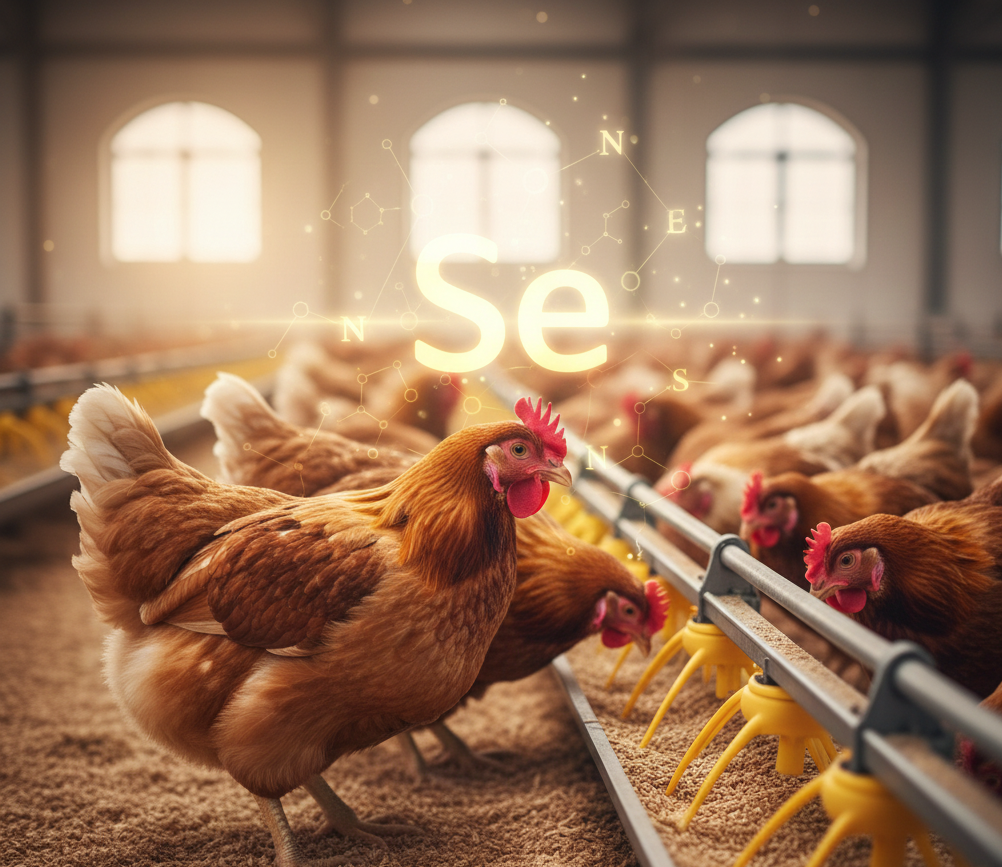
Fig: Selenium as an Essential Micronutrient in Poultry Nutrition
Effects of Selenium Sources on Broiler Performance
Different selenium sources vary in bioavailability, metabolic efficiency, and biological effects.
- Inorganic Selenium (Sodium Selenite): Although widely used, it has limited bioavailability and can be unstable under certain feed conditions. High doses may induce toxicity or interact negatively with other minerals (Dalia et al., 2017).
- Organic Selenium (Selenomethionine and Selenium Yeast): These forms are more efficiently absorbed and stored in body tissues, providing a long-term selenium reserve. They improve growth rate, feed efficiency, and antioxidant capacity more effectively than inorganic forms (Khan et al., 2018).
- Nano-Selenium: A newer innovation, nano-selenium provides superior bioavailability and safety. Studies have indicated enhanced immune response, improved antioxidant status, and better carcass quality in broilers supplemented with nano-selenium compared to conventional sources (Shi et al., 2021).
The choice of selenium source can thus determine not only growth performance but also the bird’s ability to withstand environmental and metabolic stressors.
5. Effects of Selenium Sources on Immunity, Nutrient Digestibility, and Blood Profile of Broilers
Selenium plays a critical role in immune system regulation. It enhances both humoral and cellular immunity by promoting antibody production, lymphocyte proliferation, and macrophage activity. Organic selenium sources, in particular, are more effective in stimulating immune responses than inorganic forms.
Selenium also affects nutrient digestibility by maintaining intestinal integrity and enzyme activity. Birds receiving selenium-enriched diets exhibit better gut morphology and villus height, which improve nutrient absorption and feed efficiency (Dalia et al., 2017).
Blood biochemical profiles are important indicators of selenium status and overall health. Supplementation with organic selenium increases plasma concentrations of glutathione peroxidase, total protein, and antioxidant enzymes while reducing markers of oxidative stress such as malondialdehyde (MDA). Furthermore, selenium supplementation helps stabilize lipid metabolism, reducing cholesterol and triglyceride levels in broilers (Shi et al., 2021).
6. Conclusion
Selenium is an indispensable micronutrient in poultry nutrition, influencing a wide range of physiological and metabolic processes. From improving growth performance and feed efficiency to enhancing immune function and oxidative stability, its benefits are well-documented.
The effectiveness of selenium supplementation largely depends on its chemical form. Organic and nano-selenium sources are increasingly preferred due to their superior bioavailability, retention, and efficacy compared to traditional inorganic forms. By incorporating optimal selenium sources into poultry diets, producers can ensure better productivity, disease resistance, and overall bird welfare—key factors in sustainable poultry production.
As research advances, precision nutrition strategies using innovative selenium forms will continue to enhance poultry performance, contributing to safer and more efficient food production systems.
References (APA Style)
Abd El-Hack, M. E., El-Saadony, M. T., Shafi, M. E., Zabermawi, N. M., Arif, M., Batiha, G. E., Khafaga, A. F., Abd El-Hakim, Y. M., & Al-Sagheer, A. A. (2017). Impact of probiotics, prebiotics, and synbiotics on production, health, and immunity of poultry. World’s Poultry Science Journal. Retrieved from https://consensus.app/papers/impact-probiotics-prebiotics-synbiotics-production-health-abd/4b51d4b379775ea1b49cfb236bd981e0/?utm_source=chatgpt
Choct, M., Naylor, A. J., & Reinke, N. (2017). The role of selenium in poultry health and production. World’s Poultry Science Journal. Retrieved from https://consensus.app/papers/role-selenium-poultry-health-choct/3d8dba1e8b1b5561b8c77acfc661c63c/?utm_source=chatgpt
Dalia, A. M., Loh, T. C., Sazili, A. Q., Jahromi, M. F., & Samsudin, A. A. (2017). Effect of selenium supplementation on broiler performance, antioxidant capacity, and meat quality. Poultry Science Journal. Retrieved from https://consensus.app/papers/effect-selenium-supplementation-broiler-performance-dalia/dab0d9c4ed025bfbbcb4d6b9921972d0/?utm_source=chatgpt
Khan, M. Z., Akram, M., & Hussain, S. (2018). Impact of organic selenium on growth performance and antioxidant status in broiler chickens. Asian-Australasian Journal of Animal Sciences. Retrieved from https://consensus.app/papers/impact-organic-selenium-growth-performance-chickens-khan/bac2a7b5d3b24f6ea8d8765bcabfd13f/?utm_source=chatgpt
Shi, L., Xun, W., Yue, W., Zhang, C., Ren, Y., & Liu, Q. (2021). Nano-selenium improves growth performance, immunity, and antioxidant capacity in broiler chickens. Animal Feed Science and Technology. Retrieved from https://consensus.app/papers/nano-selenium-improves-growth-immunity-chickens-shi/9d7b817cb5a55d49a67f9e19e425e2a1/?utm_source=chatgpt
Surai, P. F. (2018). The role of selenium in broiler nutrition and health. Poultry Science Journal. Retrieved from https://consensus.app/papers/role-selenium-broiler-nutrition-surai/5b3a9f8a3d554bdeabc91938a6e97d25/?utm_source=chatgpt