
Converting Poultry Manure into Organic Fertilizer
Introduction
Poultry sector is significantly contributing in meeting the rapidly growing demand for animal protein origin foods such as meat and eggs. But during production process it also creates a large amount of waste called poultry manure including, droppings, urine, bedding material and leftover feed. The manure of poultry has high potential of gradual nutrient release associated with it’s rich nutrients content like nitrogen, phosphorus and potassium. These essential nutrient play supporting role for plant nourishment and also provide disease resistance. Although poultry manure is rich in nutrient but needs desirable treatment first to make its safe and easy use (Moore et al., 1995). Moreover, by converting poultry manure into fertilizer, farmers can protect environment and can also save money. This seems a true example of turning waste into wealth. Fresh manure is wet, smelly, and can contain germs or parasites. If used directly, it might burn plants becomes a source of wide variety of infectious agents that can cause disease in humans (Millner, 2009).
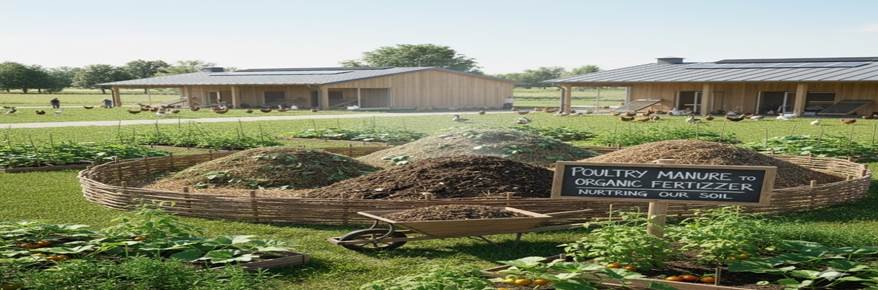
Fig: Conversion of poultry manure into nutrient-rich organic fertilizer a sustainable solution.
Processing or treating the manure removes harmful elements, reduces the smell, and turns it into a safe, natural fertilizer. The poultry manure is considered as a valuable organic fertilizer for crops and this waste material can actually be turned into useful organic fertilizer by different methods.
- Composting: is a key building block for organic farming and in this method poultry manure is recycled. This is known as a convenient method to improve soil fertility and its biological value. Controlled compost may destruct both, pathogens and weeds Moreover, composted materials can be stored for a longer time and their applications becomes much easier (Zaborski., 2019). Further, compost can aid in conversion of biodegradable organic matter into the humus like substance (Yu eta la.,2019). The potential factors i.e temperature, pH, organisms present, Carbon:Nitrogen ratio, aeration including particle size, pile size and turning should be considered while making compost (Biernbaum and Fogiel, 2004). The controlled compost is full of nutrients and safe for use in vegetable gardens. Besides, soil amendment, compost can increase soil water holding capacity (Cogger, 2005).
- Vermicomposting: This is method of decomposition of organic waste by the addition of earthworms, yielding a better end product know as vermicompost. Earthworms helps to turn the manure into rich, soft fertilizer. Further, worms eat the manure and produce worm castings a fine, black compost, great for plant growth and health.In view of the growing awareness about vermicomposting people are adopting this on small household and farm level and can be made in bin and in pile (Rostami, 2011).
- Drying and Pelletizing: Large farms or companies often dry the manure and press it into pellets. Pelleted manure is easy to handle, store, and transport. It’s also a convenient option for big farms that need fertilizer in large quantities. By using in this form essential nutrients like nitrogen, phosphorus and potassium are supplied to soil (Hao and He, 2020). These essential nutrients improve plant growth and yield by boosting soil condition. Further, it improves water retention, and aeration which ultimately led to healthier environment and address sustainability over time and cost-effectiveness.
Conclusion
Converting chicken manure into organic fertilizer is a suitable farm practice. As an alternative, agriculturalists can reprocess and use this for fruitful purposes such as for yielding healthier crops and increase profit margin. Controlled composting can give a lot of benefits to farmer community, composting application is helpful for soil and planet.
References
- Biernbaum JA, Fogiel A. Compost production and use. InUpper Midwest Organic Farming Conference 2004 Feb. WI: La Crosse.
- Cogger CG. Potential compost benefits for restoration of soils disturbed by urban development. Compost science & utilization. 2005 Sep 1;13(4):243-51.
- Hao X, He Z. Pelletizing animal manures for on‐and off‐farm use. Animal manure: Production, characteristics, environmental concerns, and management. 2020 Jan 22;67:323-44.
- Moore Jr PA, Daniel TC, Sharpley AN, Wood CW. Poultry manure management: Environmentally sound options. Journal of soil and water conservation. 1995 May 1;50(3):321-7.
- Rostami R. Vermicomposting. InIntegrated Waste Management-Volume II 2011 Aug 23. IntechOpen.
- Yu H, Xie B, Khan R, Shen G. The changes in carbon, nitrogen components and humic substances during organic-inorganic aerobic co-composting. Bioresource technology. 2019 Jan 1;271:228-35.
- Zaborski, E., 2019. Composting to reduce weed seeds and plant pathogens.

buy cannabis capsules online safe and tested
ok