
Mycotoxin Management in Poultry: Practical Tips for high profit
Mycotoxins are low molecular weight secondary metabolites widely occur in nature produced by certain fungi (molds). It is said that > 300 mycotoxins known yet and almost 20 are shown to occur naturally in foods and feeds. The Aspergillus, Penicillium, and Fusarium are the main fungal genra produces these toxins and which are further categorized into aflatoxins (B1, B2, G1, G2, M1), ochratoxin A, patulin, citrinin, sterigmatocystin, and the fusarium toxins namely fumonisins (B1, B2 and B3), T-2 and HT-2 toxins, zearalenone, nivalenol, and deoxynivalenol (Ramadan and Ameri, 2022).
They contaminate feed ingredients such as Maize, wheat, sorghum, canola and soybean in the field as well as during storage conditions. Crop Pre-harverst, harvest and postharvest stage is much critical times to control mycotoxin production (Battilani et al.,2012). Mycotoxins contaminated feed often show symptoms of reduced feed efficiency, nutrient digestion, egg production, gastrointestinal disturbances, immunosuppression, kidney and reproductive problems, finally leading to high mortality if remained unchecked. Poultry farmers must manage mycotoxin issues to ensure birds health, productivity and increase profit.
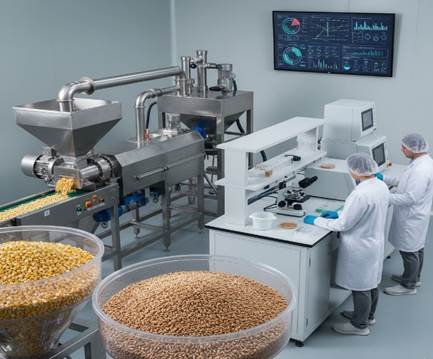
The physical (antimycotic agents, density segregation, Irradiation, mechanical separation, processing) and chemical detoxification methods (ammoniation, ozonization, sodium hydroxide and structural degradation) are also being used as good detoxify measure to control mycotoxin in feed. But the biological solutions including microbial detoxificationare, enzymatic degradation, probiotic-based mycotoxin binders, prebiotics and synbiotics, plant-derived bioactives (phytobiotics), biological detoxification during feed fermentation are easy and much reliable. These mycotoxins mainly enter in the body through contaminated feed, absorbed in intestine and transported via the bloodstream to different organs and exhibit their adverse effects. Both organic and inorganic substances act as mycotoxin-binding agents that bind to mycotoxins in the digestive tract, preventing their absorption and subsequent toxicity to humans and animals. Feed ingredients screening regarding the mycotoxins is essential for proper feed formulation. Laboratory techniques including microcolumns, thin layer chromatography, enzyme linked immuno-sorbent assay, high pressure liquid chromatography, gas chromatography and mass spectrophotometry and being used to measure mycotoxin. However, TLC and ELISA are much easy and rapid mycotoxin detection methods.
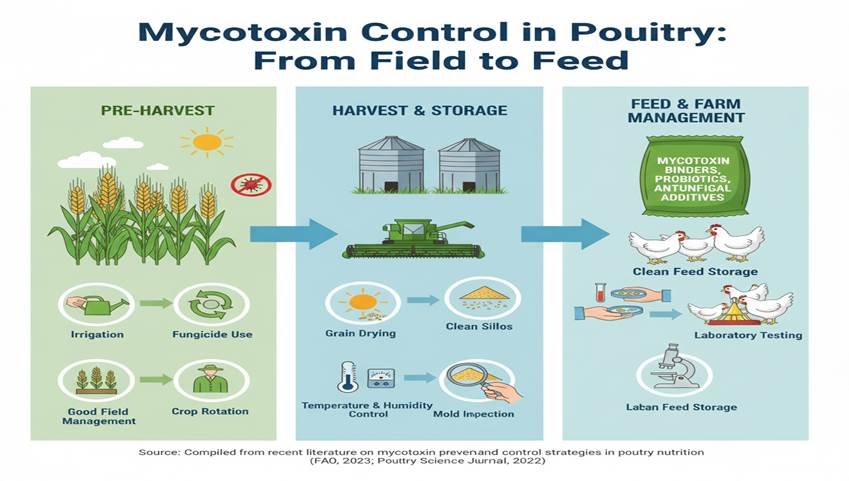
Available solutions
Bentonites: These are (hydrated aluminium silicate), natural clay minerals adsorb mycotoxins, characterized by a layered (lamellar) crystalline microstructure. Available interchangeable cations (Na+, K+, Ca++ and Mg++) in layer drive their absorption ability. Significantly higher growth of broiler was recorded upon inclusion of 0.50% bentonite (Khatoon et al.,2018). Bentonites are found to be effective in binding aflatoxin and greater swelling and adsorption capacity was noticed with sodium bentonite than calcium bentonite in Ochratoxin A control.
Yeast and probiotics. The cell wall of yeast may showpromising mycotoxin adsorbent effects in poultry and results of numerous in vitro and in vivo suggest that yeast and its derived products have capacity to adsorb mycotoxins (Xu et al.,2023). Similarly, Probiotic including Lactobacillus, Bifidobacterium, Bacillus, and Enterococcus species, may bind and bio-transform mycotoxins (Biagi, 2009). Broilers fed with combination of probiotic plus yeast (1%) reduced liver and kidney dysfunction (Motawe et al.,2014).
Anti-fungal. The fungal growth prevention is first preventive measure against mycotoxin contamination. Antifungal are (antimycotic) agents that check fungal growth, hence help to control toxin development. Although essential oils also work as antifungal agent but can’t eradicate mycotoxins completely, rather may lower severity of mycotoxin growth.
Efficacy of different Mycotoxin-binding agents
Aluminosilicates and Zeolites
Aflatoxins are among the most widely research priority area in animal production. Activated charcoal is a porous insoluble powder (mass ratio 500-3500 m2/g) may counter mycotoxins adverse effects. In poultry, clinoptilolite addition increased growth performance, while also mitigated the negative effects of aflatoxins and other mycotoxins. Inclusion of 0.2% modified clinoptilolite adsorb aflatoxins resulting in measurable improvements in health and productivity of laying hens exposed to OTA (Vasiljević et al.,2021). Moreover, an abundance of published data describes that aluminosilicates feeding substantially lower enteric diseases. Bonna et al., (1991) suggested that Hydrated Sodium Calcium Aluminosilicates (HSCAS) and/or activated charcoal included in diets that contained 102 ppb aflatoxins reduced or essentially eliminated histopathologic lesions in the livers. Inclusion of 0.05% modified HSCAS adsorbent reduced induced T-2 effects. Moreover, the additive not only improved birds growth but also reduced hepatic and small intestinal injuries (Wei et al.,2019).
Zeolites are hydrated aluminosilicate minerals and may effectively prevent heavy metal toxicity in animals due to their high ion-exchange (Sallam et al., 2024). Further, these have remarkable capacity to bind heavy metals as well as radioactive elements, consequently alter toxin excretion and uptake from animal body (Papaioannou, et al., 2005). Ivan et al., (1992) reported significantly reduced Cu level in sheep’s liver and proposed that zeolites may check copper poisoning issues.There is huge scientific data to verify that the dietary zeolites may contributes to the improvement of animal health status. Moreover, these studies also show a secondary effect of improvement in final meat and dairy product quality.
Benefits of yeast, probiotics and polymers in experimental studies
Microorganisms especially yeasts, lactic acid bacteria (LAB), and fungi may act as adsorbents. Their application is indeed a successful and increasingly known strategy for the control of mycotoxins in feeds. Inclusion of LAB and Saccharomyces cerevisiae showed unique ochratoxin A and aflatoxin (B1, B2, G1, G2) detoxification properties. The Saccharomyces cerevisiae perform mycotoxin decontamination activity through adhesion process with cell wall surface. Further, dead yeast cell walls also show functional ability to bind mycotoxins. The mannan components of yeast cell walls bind significant quantities of aflatoxins including OTA, aflatoxins and T-2 toxin. Moreover, yeast i.e Saccharomyces cerevisiae also increase health and growth of animal due its nutritional value with essential amino acids, vitamins and minerals. Certain LAB species, mainly the Lactobacillus rhamnosus, Lactobacillus plantarum, and Lactobacillus casei, exhibited remarkable adsorptive effects toward key mycotoxins such as aflatoxin B₁ , zearalenone and deoxynivalenol. Furthermore, Niderkorn et al., (2007) recognized, Lactobacillus and Leuconostoc bacteria that biotransformed zearalenone. Author also found that Streptococcus and Enterococcus strains bind deoxynivalenol, zearalenone, and fumonisins.
The synthetic polymers category have emerged as effective tools for mycotoxin management and these mainly include cholestyramine resins, polyvinylpyrrolidone and polyurethane-based polymers. In vitro study results by Alegakis et al., (1999) show that synthetic water soluble polymer polyvinlypyrrolidone may remove zearalenone and aflatoxin concentrations.
Refenes
Battilani P, Rossi V, Giorni P, Pietri A, Gualla A, Van der Fels‐Klerx HJ, Booij CJ, Moretti A, Logrieco A, Miglietta F, Toscano P. Modelling, predicting and mapping the emergence of aflatoxins in cereals in the EU due to climate change. EFSA Supporting Publications. 2012 Jan;9(1):223E.
Bonna R. J., Aulerich R. J., Bursian S. J., Poppenga R. H., Braselton W. E. and Watson G. L. (1991). Efficacy of hydrated sodium calcium aluminosilicate and activated charcoal in reducing the toxicity of dietary aflatoxin to mink. Arch Environ Contam Toxicol 20: 441-447.
Galvano F, Piva A, Ritienia and Galvano G (2001). Dietary strategies to counteract the effects of mycotoxins : A review. Journal of Food Protection, 64: 120-131.
Ivan M, Dayrell MD, Mahadevan S, Hidiroglou M. Effects of bentonite on wool growth and nitrogen metabolism in fauna-free and faunated sheep. Journal of Animal Science. 1992 Oct 1;70(10):3194-202.
Khatoon A, Khan MZ, Abidin ZU, Bhatti SA. Effects of feeding bentonite clay upon ochratoxin A–induced immunosuppression in broiler chicks. Food Additives & Contaminants: Part A. 2018 Mar 4;35(3):538-45.
Motawe HF, Salam AA, El Meleigy KM. Reducing the toxicity of aflatoxin in broiler chickens’ diet by using probiotic and yeast. International Journal of Poultry Science. 2014 Jul 1;13(7):397.
Okey SN, Ogbu CC, Akomas SC, Okoli IC. Effect of activated charcoal on different aspects of poultry performance: a review. Journal of Sustainable Veterinary and Allied Science. 2021 Jan 1;1(1):85-8.
Ramadan NA, Al-Ameri HA. Aflatoxins. InAflatoxins-occurrence, detoxification, determination and health risks 2022 Feb 9. IntechOpen.
Sallam GR, Aly HA, Lotfy AM, Abdel-Rahim MM, Fayed WM, Teiba II, Mzengereza K, Tembo M, Singini W, Habib YJ, Shehata AI. Natural zeolite for heavy metal, ammonia removal, and physiological responses in European sea bass (Dicentrarchus labrax) juveniles tanks with different densities. Plos one. 2024 Apr 5;19(4):e0297844.
Vasiljević M, Marinković D, Milićević D, Pleadin J, Stefanović S, Trialović S, Raj J, Petrujkić B, Trialović JN. Efficacy of a modified Clinoptilolite based adsorbent in reducing detrimental effects of Ochratoxin a in laying hens. Toxins. 2021 Jul 7;13(7):469.
Wang Y, Zhang C, Wang J, Knopp D. Recent progress in rapid determination of mycotoxins based on emerging biorecognition molecules: A review. Toxins. 2022 Jan 20;14(2):73.
Wei, J.T., Wu, K.T., Sun, H., Khalil, M.M., Dai, J.F., Liu, Y., Liu, Q., Zhang, N.Y., Qi, D.S. and Sun, L.H., 2019. A novel modified hydrated sodium calcium aluminosilicate (HSCAS) adsorbent can effectively reduce T-2 toxin-induced toxicity in growth performance, nutrient digestibility, serum biochemistry, and small intestinal morphology in chicks. Toxins, 11(4), p.199.
Xu R, Yiannikouris A, Shandilya UK, Karrow NA. Comparative assessment of different yeast cell wall-based mycotoxin adsorbents using a model-and bioassay-based in vitro approach. Toxins. 2023 Jan 24;15(2):104.


Mycotoxins in feed are indeed a serious issue that can affect the health and productivity of poultry. It’s interesting to see how both physical and chemical methods are used to control them, but biological solutions seem to be more sustainable and reliable. The use of microbial detoxification and phytobiotics is particularly fascinating, as it aligns with safer and eco-friendly practices. I wonder, though, how effective these biological methods are compared to traditional chemical detoxification in the long term. Also, could there be any unintended consequences of using biological agents in feed? The emphasis on regular screening of feed ingredients is crucial, but are there any cost-effective methods for small-scale farmers to implement these practices? Overall, the integration of these methods seems promising for ensuring animal health and productivity. What are your thoughts on the practicality of using zeolites as mycotoxin-binding agents?
Mycotoxins is a great problem of world poultry. Refrence to recent meta analysis “Evaluating zeolite stability as a mycotoxin binder in broiler chickens’
growth performance: A meta-analysis”. zeolite supplementation, particularly clinoptilolite,
represents a viable dietary strategy for mitigating mycotoxin exposure in poultry production
systems by enhancing growth performance and alleviating mycotoxin-related adverse
effects.